Table of Contents
- 1. How Much Does a Meal Subscription App Cost in 2026?
- 2. Why Does Custom Meal Prep Software Cost Six Figures?
- 3. What Hidden Expenses Catch SaaS Subscribers Off Guard?
- 4. What Ongoing Operating Costs Remain After Buying White-Label Code?
- 5. How to Budget Smartly for Single-Brand vs Multi-Client Launch
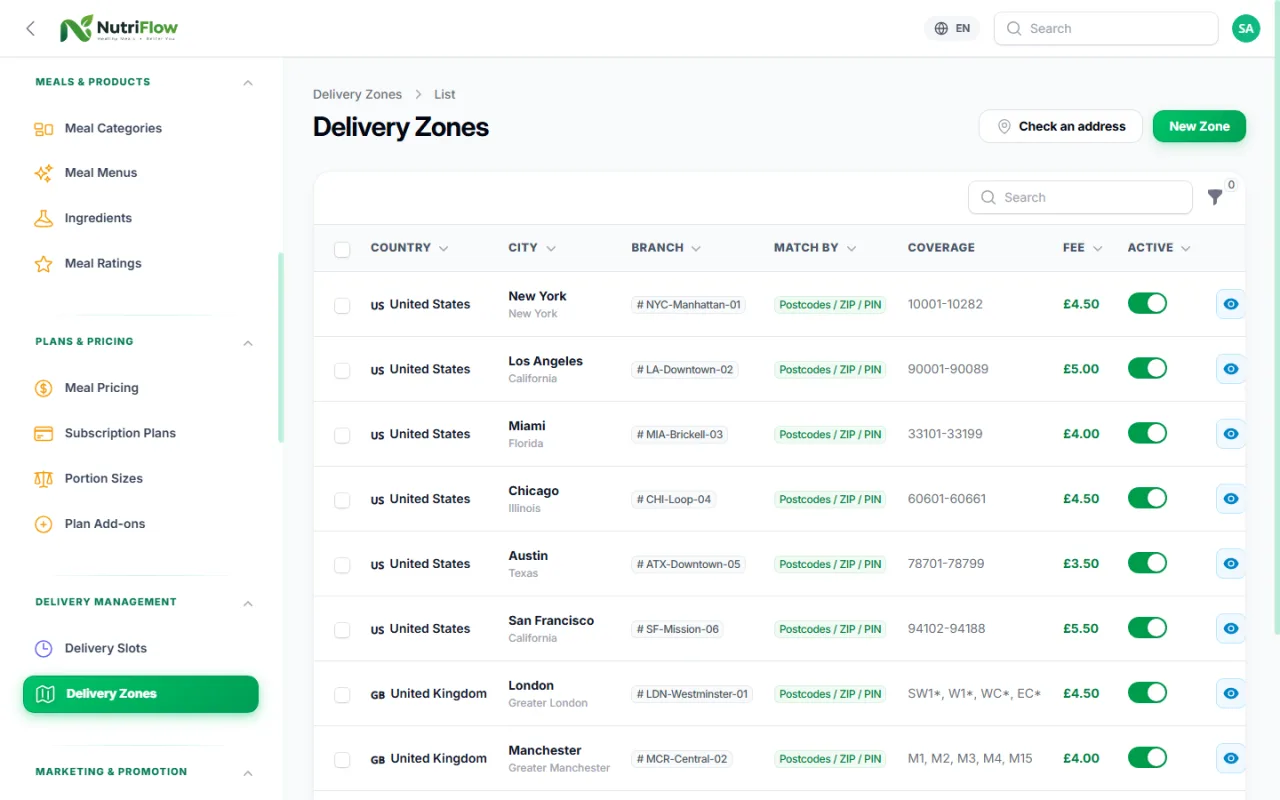
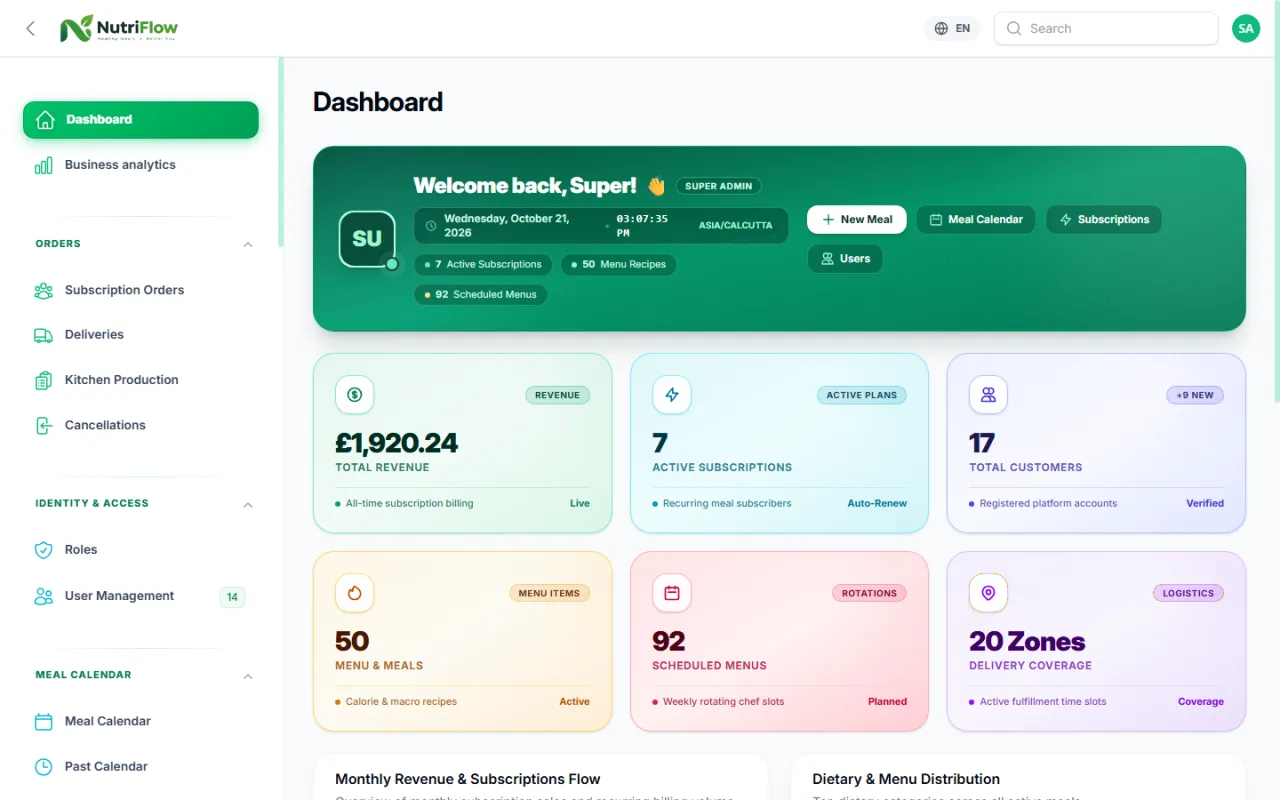
NutriFlow is standalone white-label meal subscription software. Before committing capital to engineering contracts or recurring SaaS subscriptions, every cloud kitchen founder, dietitian, and digital agency asks one critical financial question: what is the true development cost of a production meal prep app?
Building a full meal subscription ecosystem from scratch—Next.js storefront, native Flutter iOS & Android apps, Laravel kitchen backend, PostGIS delivery geofencing, and AI nutrition matching—costs $120,000 to $220,000+ and 9–14 months with an agency. Turnkey NutriFlow white-label source code replaces custom R&D with a one-time commercial license quoted cleanly via WhatsApp.
1. How Much Does a Meal Subscription App Cost in 2026?
Direct Answer: A bespoke meal subscription app costs $120,000–$220,000 to engineer from scratch because it requires a recurring calendar state machine, dual kitchen prep sheets, PostGIS polygon geofencing, native iOS/Android checkout, and allergen filters. Hosted SaaS rentals reduce upfront spend but extract monthly retainers and transaction commissions indefinitely, whereas turnkey white-label source code offers fixed one-time licensing.
Unlike simple e-commerce stores where customers purchase a static SKU once, recurring meal prep requires tightly synchronized mobile UX, automated cutoff locks, ingredient-level allergen inheritance, and last-mile courier dispatch. Underestimating any single layer creates costly post-launch rebuilds.
| Deployment Model | Initial Capital Cost | Recurring Platform Fees | Launch Timeline | Source Code Ownership |
|---|---|---|---|---|
| Custom Agency / Scratch Build | $120,000 – $220,000+ | $3,500 – $6,000/mo DevOps & QA | 9 – 14 months | 100% if contracted properly |
| Hosted Multi-Tenant SaaS | $1,000 – $5,000 onboarding | Monthly tier + 2%–6% order/revenue fees | 1 – 4 weeks | 0% (Locked on vendor servers) |
| NutriFlow White-Label Source Code | One-time commercial license (WhatsApp quote) | 0% platform fees / 0% commissions | Days to weeks (3-Step Installer) | 100% unencrypted repository |
2. Why Does Custom Meal Prep Software Cost Six Figures?
Direct Answer: Custom engineering costs escalate because a single kitchen launch actually requires five interconnected software products rather than one app. Agencies must architect customer onboarding, recurring web and native mobile calendars, PostGIS geospatial zones, kitchen batch sheets, and executive financial controls separately—multiplying senior backend, mobile, and QA hours across every integration milestone.
Let us break down what senior engineering teams realistically bill when scoping an uncompromised meal subscription platform:
| Engineering Workstream | Typical Scope & Complexity | Estimated Custom Agency Cost |
|---|---|---|
| 1. Discovery, Figma UX & RTL Design | 41 mobile screens + responsive desktop flows + bilingual EN (LTR) & Arabic (RTL) variants | $12,000 – $20,000 |
| 2. Backend API, Cutoffs & Billing State Machine | Laravel/Node REST API, Stripe recurring billing, pause/skip wallets, midnight cutoff workers, FIFO stock | $35,000 – $60,000 |
| 3. PostGIS Geofencing & 2-Slot Dispatch | GeoJSON polygon drawing tools, radial km surcharges, AM/PM driver manifests & COD tracking | $15,000 – $25,000 |
| 4. Native iOS & Android Flutter Apps | Biometrics, Stripe PaymentSheet (Apple/Google Pay), offline calendar sync, push cutoff reminders | $32,000 – $55,000 |
| 5. Kitchen Production & AI Nutrition Engine | Configurable Claude AI intake, 14-allergen lockouts, vision plate OCR, printable batch sheets | $20,000 – $38,000 |
| 6. Automated QA, Store Review & DevOps | 174+ automated tests, CI/CD pipelines, PostgreSQL tuning, App Store & Play Store compliance | $10,000 – $22,000 |
Look closer at PostgreSQL PostGIS delivery geofencing and 14-allergen sub-ingredient inheritance: those two domain engines alone save months of costly edge-case debugging when switching to turnkey architecture.
3. What Hidden Expenses Catch SaaS Subscribers Off Guard?
Direct Answer: Low upfront SaaS plans often disguise steeply compounding 3-year costs through gross transaction fees, paid module add-ons for native mobile apps, expensive agency workarounds for regional payment gateways, and hard platform lock-in. At moderate scale of 500–800 subscribers, percentage take-rates rapidly exceed the cost of owning private commercial software source code outright.
- Percentage Revenue Erosion: A 3.5%–5% per-order commission on $250,000 monthly gross subscription billings costs $105,000 to $150,000 every single year in pure platform toll.
- Generic Web Wrappers Instead of Native Apps: Many no-code meal platforms keep buyers on mobile browsers or charge steep enterprise surcharges to list separate iOS and Android binaries.
- Regional Payment & RTL Limitations: Operators in Saudi Arabia, UAE, Kuwait, or India routinely hit walls when requesting local gateways (Tap, Moyasar, HyperPay, Razorpay) or native Cairo-font Arabic RTL parity.
- Zero Asset Value at Exit: Acquirers apply valuation discounts when your ordering engine, customer experience, and roadmap belong cleanly to a third-party multi-tenant landlord.
Building a Similar Meal Subscription Platform?
Get complete, unencrypted Flutter mobile apps, Laravel 12 multi-kitchen API, and Next.js 16 storefront code with zero ongoing revenue commissions.
Inquire on WhatsApp4. What Ongoing Operating Costs Remain After Buying White-Label Code?
Direct Answer: When licensing NutriFlow white-label meal subscription software via a one-time fee, zero commissions are paid to NutriFlow ever again. Your only ongoing technical costs are commodity cloud hosting for PostgreSQL/Redis/Next.js, direct processor fees from Stripe or your regional gateway, standard Apple/Google developer memberships, and operator-capped Anthropic Claude AI usage.
- Managed Cloud Hosting (VPS / Managed PostgreSQL + Redis): You host directly on AWS, DigitalOcean, Hetzner, or Gulf regional cloud servers under your own billing control.
- Merchant Payment Processing: Connect your own Stripe (Apple Pay / Google Pay), Tap, Moyasar, HyperPay, or Cash on Delivery reconciliation workflows with zero intermediary markups.
- Anthropic Claude API Usage (Capped): Set strict daily or monthly token budget limits inside Filament Admin; deterministic Harris-Benedict / Mifflin-St Jeor biometric math steps in seamlessly as fallback.
- Mobile App Store Accounts: Maintain your company's own Apple Developer ($99/year standard Apple fee) and Google Play ($25 one-time Google fee) store listings cleanly.
5. How to Budget Smartly for Single-Brand vs Multi-Client Launch
Direct Answer: Match your licensing budget cleanly to expansion scope before purchasing. Single cloud kitchens, gyms, and nutrition clinics benefit most from a Single-Brand Commercial License covering one domain and app store identity, while digital agencies or multi-concept food groups maximize ROI through a Multi-Client Agency License supporting unlimited client deployments.
- Step 1 — Audit Your Domain Requirements: Decide whether you need one branded storefront/app pair or white-labeled multi-client agency rights (read our White-Label vs SaaS vs Custom comparison).
- Step 2 — Verify Infrastructure & Region Fit: Confirm your payment processor (Stripe, COD, GCC, or Razorpay) and bilingual EN/AR requirements.
- Step 3 — Request a Direct Commercial Quote: Contact the NutriFlow team directly via WhatsApp Direct Chat with your business model to get exact one-time license options.
- Step 4 — Deploy via 3-Step Web Installer: Validate server prerequisites, connect PostgreSQL PostGIS, customize branding tokens, and ship to subscribers rapidly.
Frequently Asked Questions

Mohsin
Lead Solutions Architect & FounderMohsin is the founder and lead solutions architect of NutriFlow, specializing in scalable food-tech infrastructure. He leads technical architecture for NutriFlow white-label meal subscription software, designing high-throughput kitchen dispatch systems, Flutter mobile applications, and predictive retention engines.