Table of Contents
- 1. The 3 Architectural Paths for Food Subscription Platforms
- 2. The True Total Cost of Ownership (TCO) Analysis
- 3. The Strategic Hazards of Multi-Tenant SaaS Rentals
- 4. The Turnkey White-Label Alternative: Full Unencrypted Ownership
- 5. Speed-to-Market: 72 Hours vs 12 Months
- 6. Deep Stack Architecture: Next.js 16, Flutter 3 & Laravel 12
- 7. Strategic Decision Blueprint for Operators & Agencies
Every culinary entrepreneur, digital agency founder, and expanding cloud kitchen operator launching a meal prep subscription platform faces an existential architectural dilemma: Should you assemble an internal software engineering team to code a proprietary system from scratch, rent a multi-tenant SaaS subscription platform, or acquire unencrypted turnkey white-label commercial source code?
The consequences of this single technological choice compound over years. An ill-advised approach can incinerate hundreds of thousands of dollars in engineering burn, delay your market launch by over a year, or permanently siphon off 3% to 6% of your top-line gross revenues in platform processing royalties. In this comprehensive architectural guide, we dissect the total cost of ownership (TCO), developer maintenance overhead, subscriber retention physics, and enterprise valuation multiples across all three delivery models.
1. The 3 Architectural Paths for Food Subscription Platforms
When architecting a production-grade meal delivery service, businesses inevitably evaluate three core technology deployment strategies:
- Bespoke In-House Engineering: Hiring a dedicated team of frontend, mobile, backend, and DevOps engineers to architect an application from a blank canvas.
- Multi-Tenant SaaS Rental: Paying monthly recurring subscription fees plus a transaction surcharge to lease an off-the-shelf platform hosted in a shared cloud environment.
- Turnkey White-Label Commercial Source Code: Licensing a battle-tested, production-ready codebase (Laravel 12, Flutter 3, Next.js 16) with 100% unencrypted source code rights, deployed to your own private cloud infrastructure with zero recurring platform commissions.
| Evaluation Dimension | Bespoke Custom Build | Multi-Tenant SaaS | NutriFlow White-Label Turnkey |
|---|---|---|---|
| Time to Market | 9 to 14 months | 1 to 3 weeks | 48 to 72 hours |
| Initial Capital Expenditure | $140,000 – $220,000 | $1,500 – $5,000 setup | Fixed one-time license |
| Ongoing Platform Royalties | 0% (Infra only) | 2% – 6% gross revenue tax | 0% platform royalties forever |
| Source Code Ownership | 100% owned | 0% owned (Vendor lock-in) | 100% unencrypted source code |
| Native iOS & Android Apps | Requires separate build ($60k+) | Usually web-only or generic PWA | Native Flutter 3 (174 unit tests) |
| Database & Data Sovereignty | Full control | Held in vendor multi-tenant DB | Private PostgreSQL / Redis instance |
2. The True Total Cost of Ownership (TCO) Analysis
Entrepreneurs who haven't previously managed complex digital logistics frequently underestimate the engineering surface area of meal subscription platforms. A viable commercial system requires far more than an online shopping cart with Stripe recurring billing; it demands a real-time reactive ecosystem.
To build this platform in-house requires contracting or employing four specialized senior developers over a standard 10-month development cycle:
- Senior Full-Stack Backend Engineer (Laravel/PostgreSQL): Responsible for subscription state machines, wallet ledgers, cutoff queue workers, and PostGIS polygon geofencing. ($110,000 annualized base).
- Senior Mobile Engineer (Flutter/Dart): Tasked with building 41 custom screens, biometric authentication, offline calendar synchronization, and Stripe PaymentSheet integrations. ($115,000 annualized base).
- Senior Frontend Engineer (Next.js/React/Tailwind): Dedicated to high-converting onboarding funnels, calorie calculators, and bidirectional LTR/RTL rendering. ($105,000 annualized base).
- DevOps & QA Automation Lead: Structuring CI/CD pipelines, Dockerized deployments, and load-testing concurrent cutoff surges. ($110,000 annualized base).
Factoring in recruiting fees, cloud staging environments, design systems, and third-party API licenses, a ground-up custom build easily exceeds $160,000 before serving a single paying customer. Even after deployment, ongoing maintenance, security patching, and operating system updates consume a minimum of $3,500 to $6,000 per month in sustained engineering overhead.
3. The Strategic Hazards of Multi-Tenant SaaS Rentals
Multi-tenant SaaS providers lure early-stage meal prep founders with deceptively low setup fees ($199 to $499/month). However, their economic viability depends on extracting a 2.5% to 5.5% transaction commission on every subscription renewal.
Consider a thriving kitchen operating at 800 active subscribers paying $450/month ($360,000 Monthly Recurring Revenue or $4.32M Annual Recurring Revenue):
Beyond the catastrophic financial drain, SaaS platforms introduce fatal operational vulnerabilities:
- Zero Code Customization: If your culinary operation introduces a novel swapping paradigm (such as two-slot morning and evening cutoff variations), you cannot modify the compiled SaaS codebase. You are beholden to their generic product roadmap.
- Disastrous Platform Deprecations: If the SaaS vendor alters their pricing tiers, discontinues API webhooks, or gets acquired by a competitor, your operational infrastructure can be crippled overnight.
- Sub-Par App Store Presence: Most SaaS vendors cannot publish dedicated native mobile applications under your organization's specific Apple and Google Developer accounts without prohibitive enterprise surcharge tiers ($2,000+/month).
Building a Similar Meal Subscription Platform?
Get complete, unencrypted Flutter mobile apps, Laravel 12 multi-kitchen API, and Next.js 16 storefront code with zero ongoing revenue commissions.
Inquire on WhatsApp4. The Turnkey White-Label Alternative: Full Unencrypted Ownership
NutriFlow bridges the gap between off-the-shelf velocity and bespoke architectural sovereignty. Under a one-time commercial license agreement, you receive the full, unencrypted source code repository covering all four pillars of the NutriFlow ecosystem:
Next.js 16 Client Portal
Server-Side Rendered (SSR) marketing web client engineered with React 19, Tailwind CSS v4, dynamic meal configuration engines, and native LTR/RTL Arabic localization.
Flutter 3 Mobile Apps
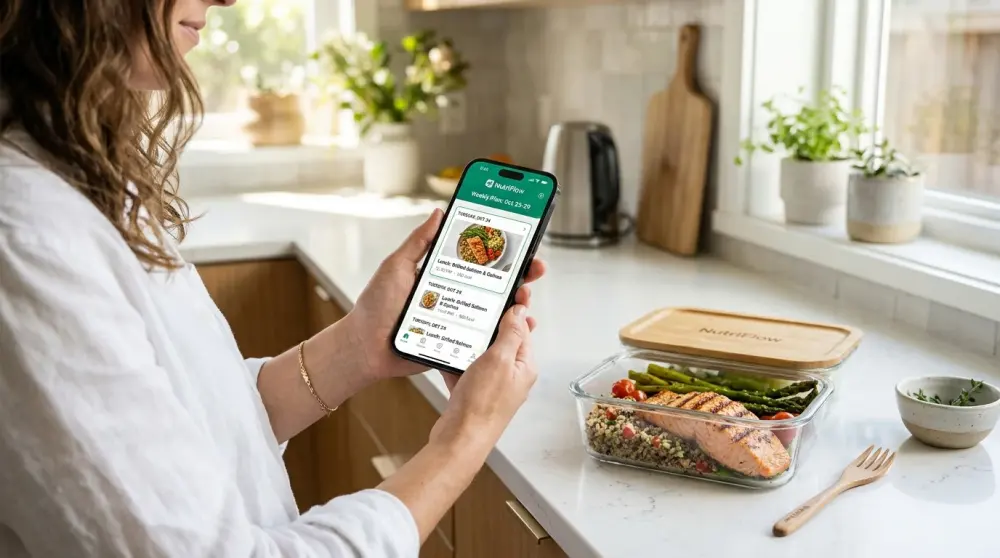
Compiled native ARM apps for iOS and Android featuring 174 unit and widget tests, Riverpod state management, biometric authentication, and native Stripe PaymentSheet checkout.
Laravel 12 Enterprise API
High-concurrency RESTful backend powered by Laravel 12, Sanctum tokens, Redis caching, robust job queues, and scheduled cutoff synchronization workers.
Dual Filament v5 Panels
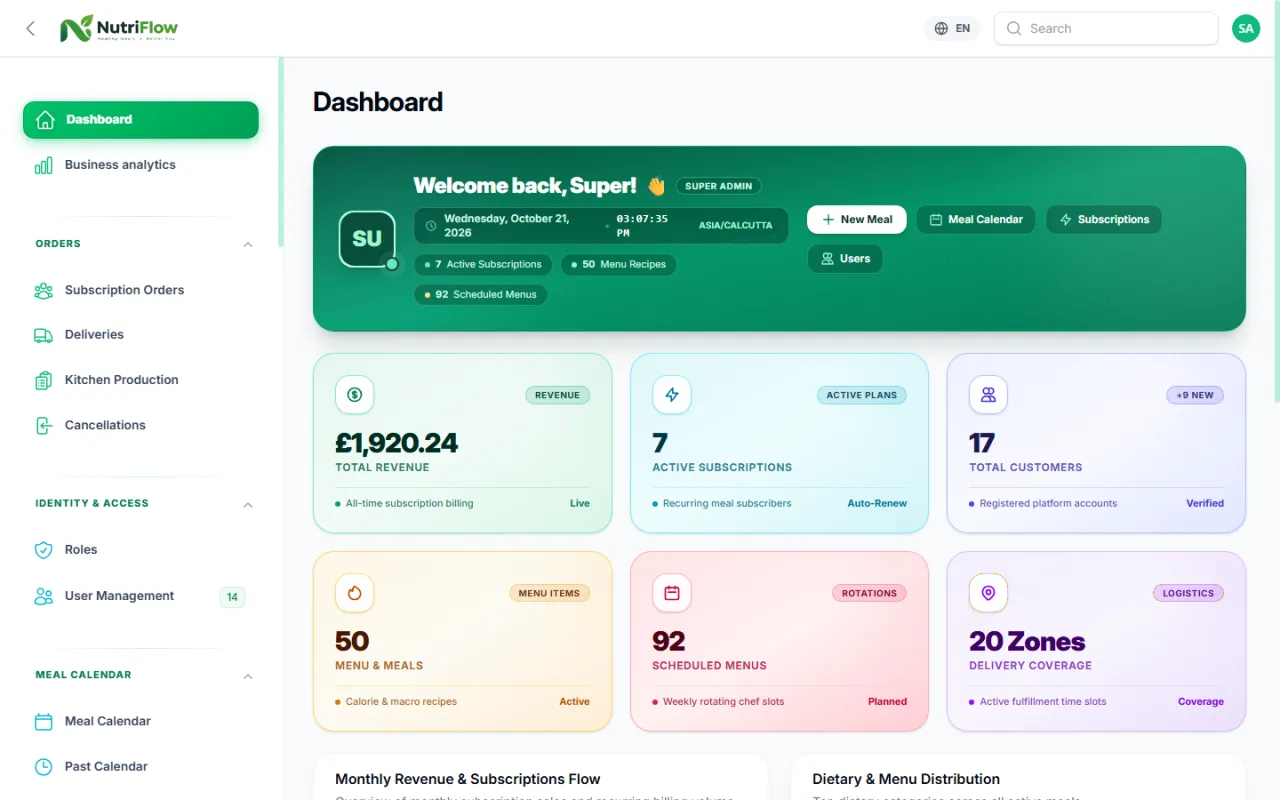
Dedicated Master Business Admin console for executives, and a high-speed Kitchen Production & Dispatch panel for real-time batch prep sheets and driver zone routing.
Because NutriFlow source code contains no obfuscated libraries or vendor callbacks, your in-house engineering team or agency can customize the UI, integrate local payment gateways (such as PayTabs, Tap, Moyasar, or Tamara), or connect proprietary kitchen robotics with zero restrictions.
5. Speed-to-Market: 72 Hours vs 12 Months
In high-growth consumer food tech, market speed determines business survival. When an entrepreneurial team spends 12 months coding a custom platform, market trends shift, operational capital dries up, and competitors establish local territory dominance.
With NutriFlow, deploying a turnkey staging and production environment requires fewer than 72 hours:
- Day 1 (Infrastructure & Branding): Clone the Git repository, configure environment variables (`.env`), set up PostgreSQL with PostGIS extensions, and compile Tailwind brand colors and custom typography.
- Day 2 (Catalog & Payments): Seed culinary menus, set up meal slots, configure cutoff time countdowns, and link production Stripe or local payment gateway keys.
- Day 3 (Mobile Deployment & Launch): Compile the Flutter 3 binary targets, submit iOS test builds to Apple TestFlight and Google Play Internal Testing, and initiate customer acquisition funnels.
6. Deep Stack Architecture: Next.js 16, Flutter 3 & Laravel 12
NutriFlow was not assembled with fragile third-party page builders or no-code plugins. It is engineered upon the modern enterprise web stack:
Next.js 16 App Router & Server Components
Utilizes React 19 Server Components to stream rendered markup to web visitors with near-instant Time to First Byte (TTFB). Includes automatic schema markup generation, OpenGraph dynamic tags, and zero-layout-shift image optimization via WebP/AVIF containers.
Flutter 3.x Native Mobile Architecture
Employs Riverpod for predictable, testable state management. Mobile clients cache weekly meal calendars locally, allowing subscribers to review their meal delivery schedule even in subterranean gym locker rooms or transit networks without cell connectivity.
Laravel 12 RESTful API & Redis Queues
Subscription recurring billing runs on atomic database transactions. Daily kitchen cutoff events—where hundreds of meal customizations lock concurrently at midnight—are processed asynchronously through Redis job workers, preventing database deadlocks and API timeouts.
7. Strategic Decision Blueprint for Operators & Agencies
When deciding between these three pathways, evaluate your long-term business horizon:
- Choose Multi-Tenant SaaS: Only if you are testing an unverified hobby project, have zero technical literacy, and plan to keep your monthly subscriber volume under 50 members.
- Choose Bespoke Ground-Up Engineering: Only if your core value proposition is proprietary computer hardware, or if you have secured $2M+ in seed venture capital specifically earmarked for a multi-year engineering runway.
- Choose NutriFlow White-Label Turnkey Code: If you are a commercial cloud kitchen, fitness club chain, culinary hospitality brand, or software agency that requires instantaneous market entry, total brand sovereignty, 100% intellectual property ownership, and zero ongoing royalty taxation.
Frequently Asked Questions

Mohsin
Lead Solutions Architect & FounderMohsin is the founder and lead solutions architect of NutriFlow, specializing in scalable food-tech infrastructure. He leads technical architecture for NutriFlow white-label meal subscription software, designing high-throughput kitchen dispatch systems, Flutter mobile applications, and predictive retention engines.