Table of Contents
- 1. The 30% Delivery App Margin Trap
- 2. Converting Volatile On-Demand Dining into Predictable MRR
- 3. Automated Batch Prep Sheets & Station Manifests
- 4. PostGIS Polygon Geofencing & Delivery Clustering
- 5. Dual-Shift Kitchen Utilization: The 24-Hour Revenue Engine
- 6. Enterprise Technology Requirements
- 7. Cloud Kitchen Scaling Roadmap: From 100 to 2,500 Daily Meals
The commercial cloud kitchen (ghost kitchen) industry has reached a pivotal reckoning. For years, culinary operators relied entirely on third-party aggregators (UberEats, Deliveroo, DoorDash, Talabat) to drive sales volume. However, as aggregator commission fees climbed past 30%, advertising surcharges exploded, and customer data was hoarded behind walled gardens, cloud kitchen operators found themselves trapped on a profitless margin treadmill.
In 2026, forward-thinking cloud kitchen groups are reclaiming their profitability by transitioning from volatile on-demand food delivery to high-margin, predictable recurring meal prep subscriptions. By locking in weekly and monthly subscribers who pay in advance, culinary operators transform erratic dinner surges into highly automated, batch-manufactured production lines. In this comprehensive operational guide, we dissect the roadmap to scaling a subscription ghost kitchen to thousands of daily meals.
1. The 30% Delivery App Margin Trap
Operating a pure on-demand cloud kitchen on third-party delivery apps is an uphill economic struggle. On a typical $25 food order, the financial breakdown reveals why operators struggle to survive:
| Cost Item | On-Demand Delivery App (30% Cut) | Direct NutriFlow Meal Subscription |
|---|---|---|
| Gross Order Value | $25.00 | $25.00 (2-meal daily delivery) |
| Third-Party Aggregator Cut | -$7.50 (30.0%) | $0.00 (0% platform cut) |
| In-App Sponsored Ad Placement | -$2.50 (10.0%) | $0.00 (Direct subscriber relationship) |
| Raw Food Ingredients (COGS) | -$6.50 (26.0%) | -$5.25 (21.0% via bulk batch buying) |
| Packaging & Disposables | -$1.50 (6.0%) | -$1.10 (4.4% via bulk tray purchasing) |
| Kitchen Production Labor | -$4.50 (18.0%) | -$3.25 (13.0% via scheduled batch shifts) |
| Delivery Driver Cost | Subsidized by platform | -$1.90 (Cluster-routed batch delivery) |
| Net Operator Profit / Loss | +$2.50 (10.0% net margin) | +$13.50 (54.0% net margin) |
2. Converting Volatile On-Demand Dining into Predictable MRR
The core operational vulnerability of on-demand restaurants is demand volatility. Rainstorms, sporting events, and algorithmic ranking changes cause order volume to swing wildly by 40% from day to day, forcing kitchens to overstaff cooks and discard spoiled inventory.
Recurring meal subscriptions convert chaotic daily volatility into smooth, mathematically predictable Monthly Recurring Revenue (MRR):
- Kitchen managers know the precise number of meals to prep 48 hours in advance.
- Protein and vegetable purveyors are issued exact purchase orders down to the ounce.
- Kitchen prep shifts operate during regular daytime hours, eliminating costly late-night overtime labor premiums.
3. Automated Batch Prep Sheets & Station Manifests
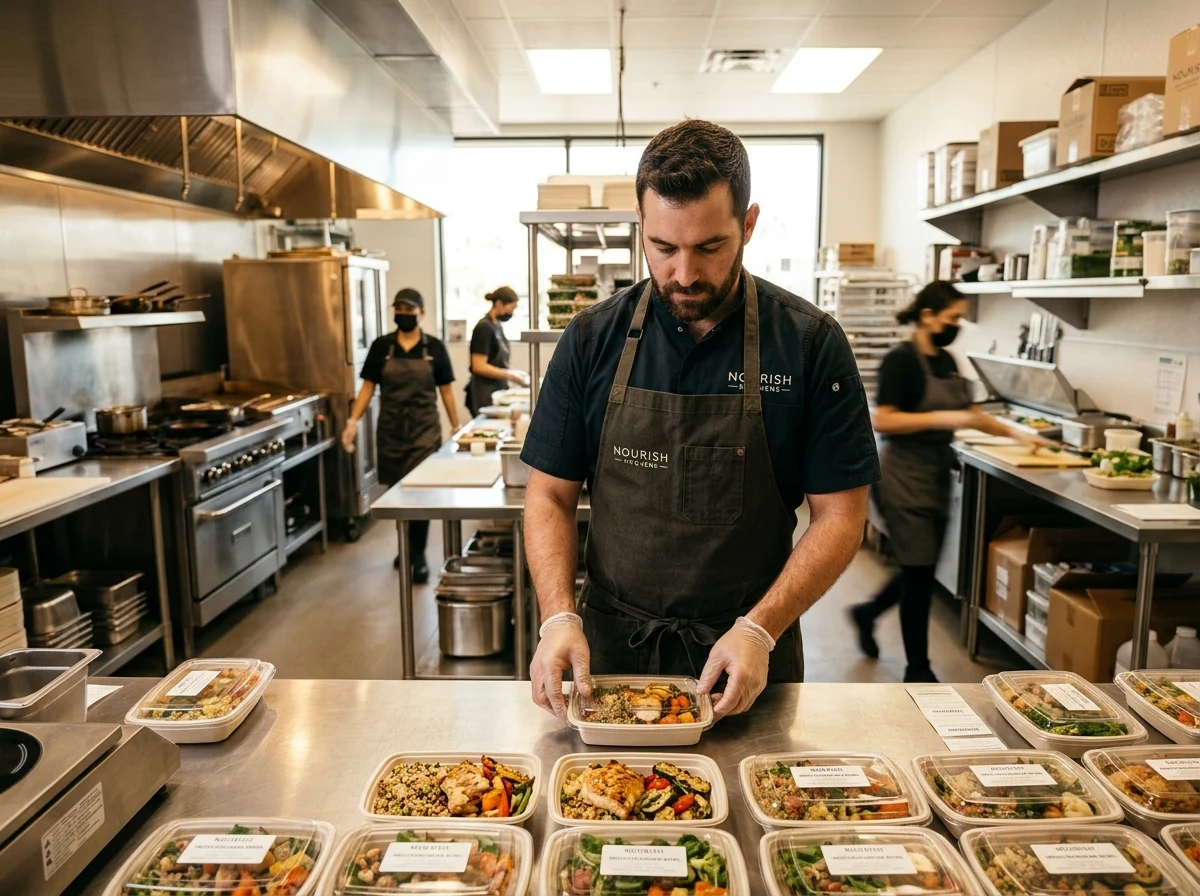
Cooking 1,000 customized meals one order at a time is impossible. Scaling subscription volume requires algorithmic batch aggregation.
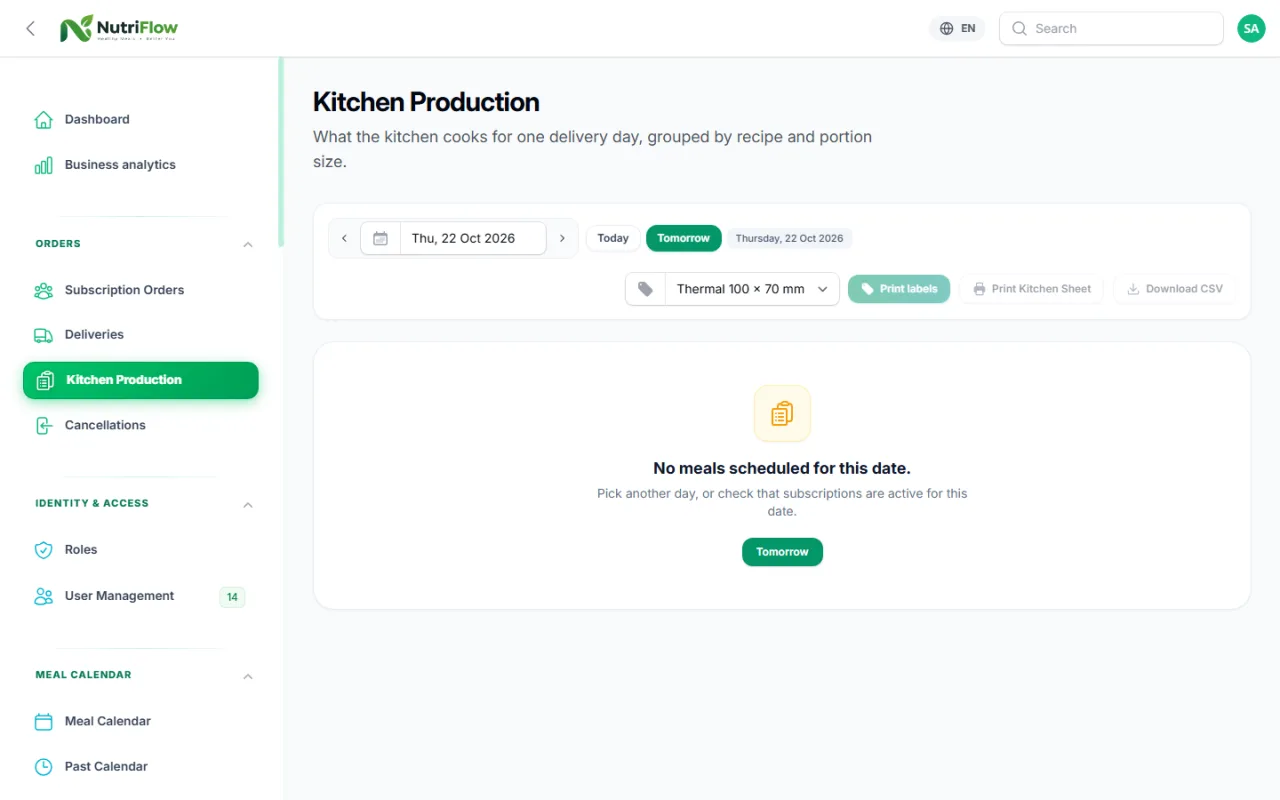
NutriFlow's kitchen engine aggregates individual subscriber orders into station-specific prep manifests automatically once the daily cutoff time arrives:
- Grill & Protein Station Sheet: Automatically tallies raw weight requirements: e.g., "Sear 42.5 kg Marinated Flank Steak; Grill 68.0 kg Herb Chicken Thighs; Bake 24.0 kg Atlantic Salmon."
- Carb & Grain Station Sheet: "Steam 55.0 kg Brown Rice; Roast 38.0 kg Sweet Potato Wedges."
- Cold Assembly & Portioning Line: Digital screens guide packers through color-coded ingredient bins, ensuring each tray receives exact gram weights and correct custom sauces.
NutriFlow integrates directly with Zebra and TSC thermal label printers. Once a tray is packed, the system prints waterproof labels displaying the subscriber name, delivery zone, exact macro profile, reheating instructions, and bold allergen warnings.
Building a Similar Meal Subscription Platform?
Get complete, unencrypted Flutter mobile apps, Laravel 12 multi-kitchen API, and Next.js 16 storefront code with zero ongoing revenue commissions.
Inquire on WhatsApp4. PostGIS Polygon Geofencing & Delivery Clustering
Last-mile delivery is the graveyard of food margin if managed improperly. Sending individual drivers on point-to-point courier trips burns capital.
NutriFlow utilizes PostGIS spatial database extensions in PostgreSQL to enforce polygon delivery boundaries:
- Kitchen operators draw custom polygon delivery zones directly on the master map.
- Deliveries within each geographic polygon are grouped into dense route clusters scheduled during dedicated morning or evening delivery windows.
- Drivers execute 16 to 22 sequential drops per hour in dense residential corridors, driving delivery cost down to under $1.50 per drop.
5. Dual-Shift Kitchen Utilization: The 24-Hour Revenue Engine
A commercial cloud kitchen space represents fixed monthly rent. Leaving cooking equipment idle during off-peak hours is an unforced financial error.
Top operators utilize NutriFlow to execute a dual-shift operational model:
- Daytime Shift (6:00 AM – 3:00 PM): The kitchen dedicates 100% of prep tables, combi-ovens, and blast chillers to batch-manufacturing scheduled meal prep subscription trays.
- Evening Shift (4:00 PM – 11:00 PM): The facility switches to fulfill on-demand virtual restaurant delivery orders, maximizing equipment utilization across a full 18-hour operating window.
6. Enterprise Technology Requirements
Running an industrial-scale meal prep operation cannot be achieved with fragile Shopify plugins or spreadsheet workarounds. Cloud kitchens require an integrated four-part software architecture:
- Next.js 16 Web Client: High-speed conversion funnels with multi-step dietary intake forms.
- Native Flutter 3 Mobile Apps: iOS and Android apps for 1-tap Apple Pay checkouts and daily cutoff push notifications.
- Laravel 12 REST API: High-throughput backend managing cutoff queues, subscriptions, and wallet credits.
- Filament v5 Kitchen Admin Panel: Shift-specific printouts, driver dispatch manifests, and real-time inventory count tracking.
7. Cloud Kitchen Scaling Roadmap: From 100 to 2,500 Daily Meals
Follow this staged trajectory to scale from a single commissary station to a high-volume regional food manufacturing powerhouse:
- Phase 1 (100–300 Daily Meals): Focus on recipe standardization, tight 14-allergen segregation, and manual batch cooking with a core 3-person kitchen team.
- Phase 2 (300–1,000 Daily Meals): Introduce industrial combi-ovens, commercial blast chillers, and automated MAP (Modified Atmosphere Packaging) tray sealers to extend shelf life to 6+ days.
- Phase 3 (1,000–2,500+ Daily Meals): Deploy multi-station conveyor assembly lines, barcode-scanned driver dispatch verification, and multi-hub cold-chain distribution.
Frequently Asked Questions

Mohsin
Lead Solutions Architect & FounderMohsin is the founder and lead solutions architect of NutriFlow, specializing in scalable food-tech infrastructure. He leads technical architecture for NutriFlow white-label meal subscription software, designing high-throughput kitchen dispatch systems, Flutter mobile applications, and predictive retention engines.