Table of Contents
- 1. The 1,500 Meals/Week Glass Ceiling
- 2. Central Production Facility (CPF) Layout & Workstations
- 3. Bulk Procurement & FIFO Inventory Integration
- 4. Precision Cold-Chain: Blast Chilling & MAP Packaging
- 5. Filament v5 Shift-Based Manifests & Station Printouts
- 6. Delivery Fleet Optimization & Route Clustering
- 7. Quality Assurance (QA) Checkpoints & Traceability
Scaling a commercial meal prep enterprise from 500 meals per week to 10,000 meals per week is not a linear challenge; it is a fundamental transformation in industrial engineering. Techniques that work in an artisanal kitchen—such as line cooks plating dishes by eye, head chefs handwriting prep clipboards, and packing meals on stainless tables—collapse into catastrophic bottlenecks, packaging errors, and food spoilage once volume crosses 1,500 weekly trays.
In 2026, manufacturing 10,000 high-protein, calorie-calibrated subscription meals weekly requires the precision of modern automotive assembly lines. It demands specialized Central Production Facility (CPF) layouts, continuous blast-chill cold chains, high-speed Modified Atmosphere Packaging (MAP), and algorithmic kitchen manifest software. In this industrial blueprint, we detail the operational mechanics required to scale safely and profitably.
1. The 1,500 Meals/Week Glass Ceiling
Most independent meal prep businesses hit an insurmountable operational wall between 1,200 and 1,800 meals per week. When an operation attempts to scale past this ceiling using traditional restaurant methods, failure manifests across three critical fronts:
- Portion Variance & Profit Erosion: When cooks eyeball protein portions, trays routinely drift 20 to 30 grams over specification. Over 10,000 meals, a 25g over-portioning of grilled beef wastes 250 kg of meat weekly, draining thousands of dollars in pure margin.
- Cutoff Processing Gridlock: Aggregating hundreds of customer dietary preferences manually in spreadsheets consumes 4 to 6 hours of valuable head chef time every evening.
- Cold-Chain Temperature Abuse: Leaving cooked food cooling at ambient room temperatures on prep tables creates microbiological bacterial hazards and dramatically curtails product shelf life.
| Operational Parameter | Artisanal Prep Kitchen (<1,500/wk) | Industrial CPF Facility (10,000+/wk) |
|---|---|---|
| Cooking Methodology | Manual saute pans & conventional ovens | Industrial Combi-Ovens & Tilting Skillets |
| Cooling Technology | Ambient room air or walk-in cooler | Roll-in Blast Chillers (90°C to 3°C in 90 min) |
| Packaging Line | Manual hand-press container lids | Continuous Conveyor Rotary MAP Sealers |
| Shelf-Life (Zero Preservatives) | 3 to 4 days refrigerated | 7 to 10 days refrigerated (via $N_2/CO_2$ gas flush) |
| Labor Efficiency | 18 to 22 meals packed per man-hour | 65 to 85 meals packed per man-hour |
2. Central Production Facility (CPF) Layout & Workstations
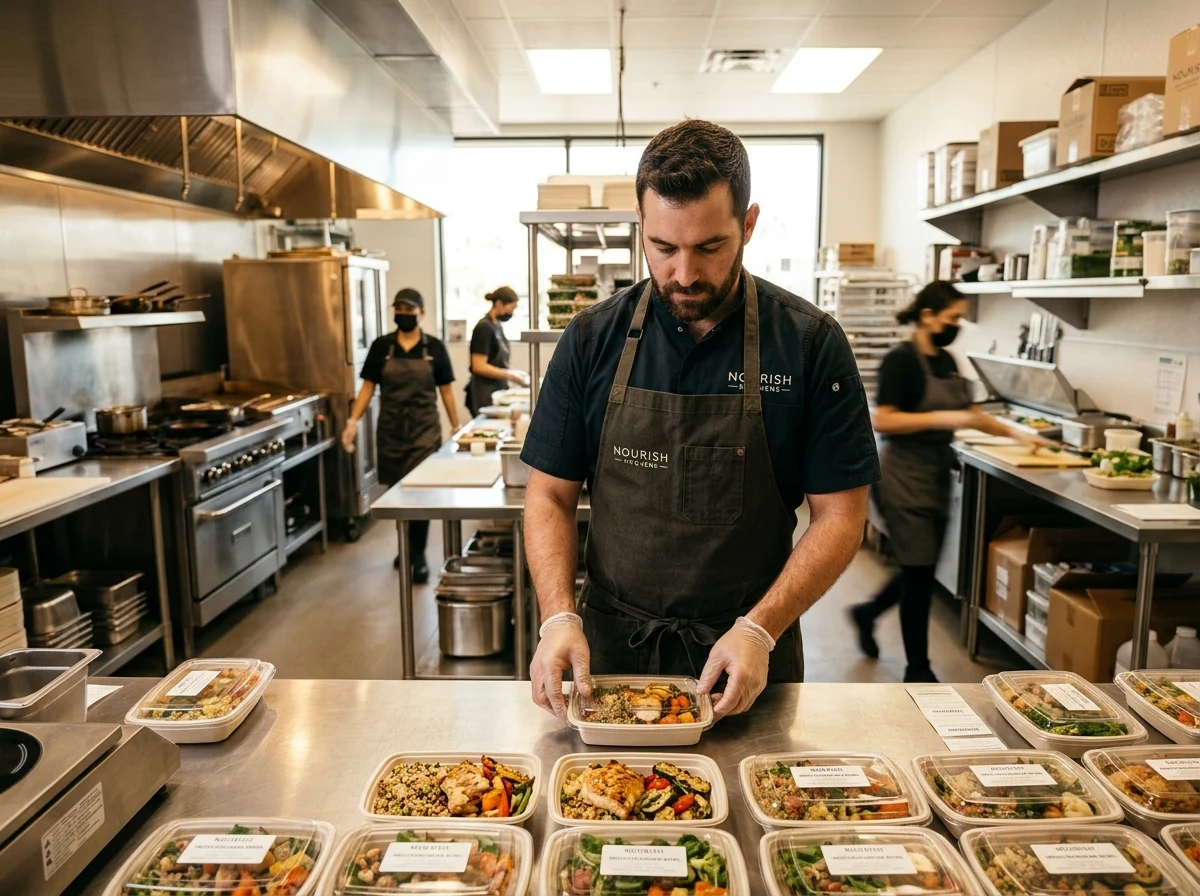
High-volume food manufacturing requires a strict Unidirectional Flow Layout. Raw ingredients must never physically cross paths with packaged ready-to-eat meals, eliminating microbiological cross-contamination:
- Zone 1: Raw Receiving & Cold Storage: Dedicated loading docks, walk-in coolers for raw proteins ($0^\circ C - 2^\circ C$), and dry goods racks.
- Zone 2: Bulk Prep & Marinade: High-capacity vegetable washers, commercial dicing machines, and vacuum-tumbler protein marinators.
- Zone 3: Thermal Cooking Suite: Bank of high-efficiency combi-steam ovens, 40-gallon tilting braising pans, and automated plancha grills with overhead hood exhaust.
- Zone 4: Rapid Blast Chilling: Trolley-mounted blast chillers that rapidly drop core food temperatures from $90^\circ C$ down to under $3^\circ C$ in under 90 minutes, arresting bacterial spore germination.
- Zone 5: Clean Assembly & MAP Sealing Room: Temperature-controlled packaging cleanroom maintained at $8^\circ C - 10^\circ C$, featuring multi-head linear scale depositors and conveyor tray sealers.
- Zone 6: Order Consolidation & Dispatch: Geofenced driver route staging bins with thermal transport insulation.
3. Bulk Procurement & FIFO Inventory Integration
Producing 10,000 meals weekly requires managing over 4,500 kilograms of raw perishables every seven days.
NutriFlow integrates directly with your procurement cycle:
- Once subscriber cutoffs lock, the system compiles consolidated Wholesale Purchase Orders (POs) for poultry, beef, seafood, complex carbohydrates, and fresh produce.
- Ingredients are tracked using strict First-In, First-Out (FIFO) inventory protocols with digital batch lot numbers.
- Kitchen inventory variance reports highlight discrepancies between theoretical recipe yields and actual raw ingredient depletion.
Building a Similar Meal Subscription Platform?
Get complete, unencrypted Flutter mobile apps, Laravel 12 multi-kitchen API, and Next.js 16 storefront code with zero ongoing revenue commissions.
Inquire on WhatsApp4. Precision Cold-Chain: Blast Chilling & MAP Packaging
The biggest secret to customer satisfaction is meal freshness. When customers open a meal tray on day 5 and find discolored vegetables or soggy proteins, they cancel their plans.
High-volume facilities rely on Modified Atmosphere Packaging (MAP):
- Food is plated into recyclable CPET or sugarcane bagasse trays.
- The MAP tray sealer draws a deep vacuum, evacuating oxygen from the container.
- The machine flushes a food-grade gas mixture (typically 70% Nitrogen, 30% Carbon Dioxide) before heat-sealing an airtight barrier film.
- Oxygen-dependent aerobic bacteria and mold cannot reproduce, extending clean-label shelf life to 8 to 10 days without adding artificial preservatives or chemical stabilizers.
Continuous automated temperature dataloggers monitor walk-in storage and blast chiller performance 24/7, sending instant SMS alerts to facility managers if temperatures exceed $4^\circ C$.
5. Filament v5 Shift-Based Manifests & Station Printouts
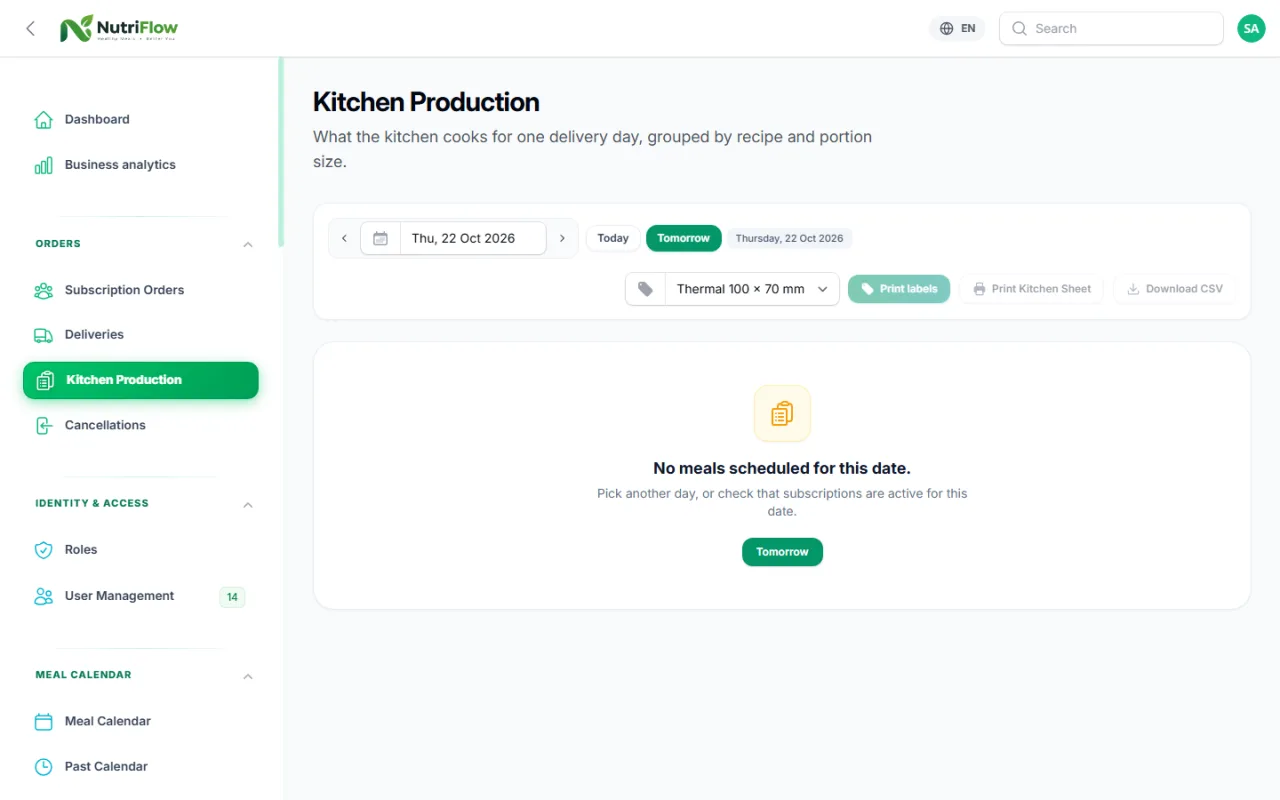
High-volume facilities operate in synchronized shifts. NutriFlow's Filament PHP kitchen console splits production across distinct station teams:
- Morning Shift (Thermal Cooking): Chefs receive aggregated cook sheets by recipe, optimizing oven batch cycles.
- Afternoon Shift (Conveyor Packing): Assembly line teams pack sealed trays, scanning barcodes to verify that the correct dish variant and subscriber custom modifications match 100%.
- Evening Shift (Route Sorting & Van Staging): Drivers scan packed insulated totes into assigned delivery cluster cages based on PostGIS delivery zones.
6. Delivery Fleet Optimization & Route Clustering
Dispatching hundreds of driver drops requires sophisticated routing algorithms. NutriFlow partitions metropolitan territories into automated route clusters:
- Each van is assigned 45 to 65 clustered stops scheduled within a tight 2.5-hour morning delivery window.
- Drivers utilize a lightweight mobile driver interface with one-tap turn-by-turn navigation and photographic proof-of-delivery (POD) capture.
- Subscribers receive automated SMS delivery confirmations with real-time doorstep photos.
7. Quality Assurance (QA) Checkpoints & Traceability
At 10,000 meals weekly, a single quality failure can jeopardize hundreds of customer accounts. NutriFlow enforces three mandatory QA gates:
- Gate 1 (Internal Core Temperature Log): Thermal probes verify that every cooked batch exceeds $74^\circ C$ (165°F) for poultry and $63^\circ C$ for beef before entering blast chillers.
- Gate 2 (Tare Weight Verification): Random statistical sampling of sealed trays across each conveyor run verifies portion weights within $\pm 3\%$ of recipe standards.
- Gate 3 (Hermetic Seal Inspection): Periodic bubble emission leak tests ensure tray film integrity and gas retention.
Frequently Asked Questions

Richie
Head of Culinary Logistics & Dietary SafetyRichie leads culinary logistics, nutritional safety, and commercial kitchen workflows at NutriFlow. With deep expertise across high-volume batch prep, dietitian-led clinical programs, and strict 14 major allergen management, Richie helps food entrepreneurs scale subscription kitchens safely.