Table of Contents
- 1. The International Regulatory Landscape
- 2. The 14 Major Food Allergens Classified
- 3. Database Schema for Zero-Tolerance Allergen Exclusions
- 4. Color-Coded Kitchen Production Zones
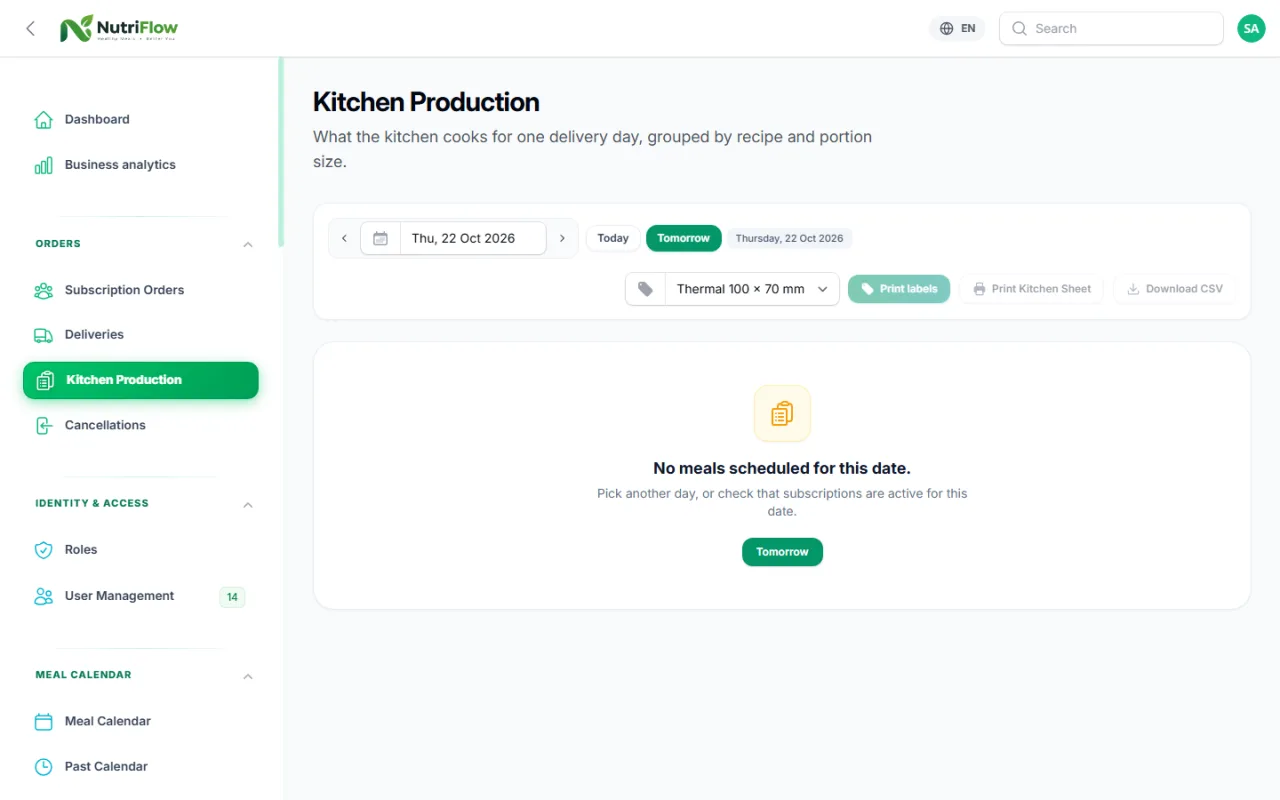
- 5. Automated Thermal Label Printing with Bold Declarations
- 6. Staff Training Protocols & HACCP Auditing
- 7. Digital Traceability & Instant Recall Protocols
In the commercial food preparation and subscription delivery sector, allergen safety is not a mere customer preference; it is a critical matter of life, death, and severe regulatory liability. An undeclared allergen or minor cross-contact incident in a high-volume commissary kitchen can trigger severe anaphylactic reactions in vulnerable subscribers, resulting in devastating legal penalties, immediate business closure, and permanent brand destruction.
In 2026, operating a legally compliant commercial meal prep platform requires full adherence to strict international food safety mandates—including the UK's Natasha's Law (Food Information Amendment), the US FDA's Food Allergy Safety, Treatment, Education, and Research (FASTER) Act, and the European Union's Regulation (EU) No 1169/2011. In this definitive operational guide, we provide the complete compliance roadmap for managing the 14 major food allergens across software, kitchen prep lines, and thermal label packaging.
1. The International Regulatory Landscape
Governments worldwide have enacted aggressive criminal and civil statutes holding food manufacturers directly responsible for allergen labeling transparency on pre-packaged foods:
- Natasha's Law (UK): Mandates that all Pre-Packed for Direct Sale (PPDS) foods must display a complete ingredient list with all 14 major allergens emphasized in bold, italic, or contrasting typography.
- FDA FASTER Act (USA): Added sesame as the 9th major food allergen, requiring strict declaration on food packaging and imposing rigorous FDA inspections on commercial food facilities.
- EU Regulation 1169/2011 (Europe): Requires unambiguous declaration of 14 specific allergenic ingredients across all pre-packaged and distance-sold foodstuffs.
| Regulatory Statute | Jurisdiction | Core Mandate for Meal Prep Platforms |
|---|---|---|
| Natasha's Law (PPDS) | United Kingdom | Mandatory full ingredient list on each container with allergens in bold font. |
| FDA FASTER Act | United States | Explicit declaration of 9 major allergens (including sesame); strict cross-contact cGMPs. |
| EU Regulation 1169/2011 | European Union | Mandatory distance-selling allergen disclosures prior to checkout and upon delivery. |
| FSANZ Standard 1.2.3 | Australia & NZ | Mandatory plain English allergen labeling (PEAL) on all food subscription deliveries. |
2. The 14 Major Food Allergens Classified
Under global standards, commercial meal prep operators must track and segregate the following 14 allergenic food categories:
Wheat, rye, barley, oats, spelt, kamut. Found in pastas, breadcrumbs, sauces thickened with flour, soy sauce.
Crabs, lobster, prawns, scampi, shrimp. Common in Asian curries, fish sauces, and seafood broth bases.
Found in mayonnaise, baked meatballs, egg-wash marinades, dressings, and breakfast scrambles.
Salmon, tuna, cod, anchovies. Often hidden in Caesar dressings, Worcestershire sauce, and kimchi.
Legumes distinct from tree nuts. Found in satay sauces, peanut oils, baked protein snacks, and granolas.
Tofu, edamame, soy protein isolate, tamari, miso, and emulsifiers (soy lecithin in cooking sprays).
Butter, whey protein powder, ghee, cheese, cream, yogurt. High cross-contact risk in shared pans.
Almonds, hazelnuts, walnuts, cashews, pecans, Brazil nuts, pistachios, macadamias. Found in pestos.
Celery stalks, celery salt, spice rubs, mirepoix soup bases, and vegetable stock concentrates.
Dijon mustard, mustard seeds, curry powders, marinades, salad dressings, and barbecue glazes.
Tahini, sesame oil, hamburger buns, hummus, Asian stir-fries, and dukkah seasonings.
Preservatives in dried fruits (raisins, apricots), wine reductions, vinegar, and pickled garlic (> 10 mg/kg).
Lupin flour and seeds used in gluten-free bakery items, keto pasta substitutes, and vegan pastries.
Mussels, oysters, squid, octopus, snails. Common in oyster sauce, bouillabaisse, and paella.
3. Database Schema for Zero-Tolerance Allergen Exclusions
Most general e-commerce software (WooCommerce, Shopify) treats food allergens as basic text tags. If a kitchen operator forgets to tag an ingredient, a subscriber with a life-threatening peanut allergy can be delivered a contaminated dish.
NutriFlow prevents human error through an enforced Relational Allergen Matrix in PostgreSQL:
- Ingredient-Level Association: Allergens are not tagged at the dish level; they are inherited dynamically from raw ingredients. If a chef adds a tablespoon of oyster sauce to a stir-fry recipe, the dish automatically inherits `Molluscs` and `Fish` tags across all customer views.
- Strict Swap Filtering: When a subscriber configures their weekly meal schedule, the database filters out any recipe containing their active allergen exclusions. The user cannot physically select an allergenic dish.
If a subscriber updates their allergen profile after meals are already scheduled, NutriFlow's background queue automatically scans upcoming scheduled orders and auto-replaces conflicting dishes with safe certified alternatives, notifying the subscriber via push notification.
Building a Similar Meal Subscription Platform?
Get complete, unencrypted Flutter mobile apps, Laravel 12 multi-kitchen API, and Next.js 16 storefront code with zero ongoing revenue commissions.
Inquire on WhatsApp4. Color-Coded Kitchen Production Zones
Having safe software is useless if physical cross-contact occurs on the kitchen prep line. High-volume facilities must implement strict Hazard Analysis Critical Control Point (HACCP) segregation:
- Color-Coded Cutting Boards & Knives: Red for raw red meat, Yellow for raw poultry, Blue for seafood/crustaceans, Green for produce, and Purple exclusively for allergen-free prep.
- Dedicated Allergen Prep Sinks: Allergen-free ingredients must never be washed in the same prep sinks used for shell eggs or shellfish thawing.
- Separate Air Flow & Baking Hours: Airborne gluten and peanut flour particles remain suspended in room air for up to 14 hours. High-risk baking prep must be scheduled at the end of production shifts followed by deep sanitation.
5. Automated Thermal Label Printing with Bold Declarations
NutriFlow integrates directly with Zebra, TSC, and Brother thermal packaging printers. As trays pass through the final packing station, the printer automatically generates compliant physical labels:
- Full ingredient list arranged in descending order of incoming weight.
- All 14 major allergens highlighted in BOLD UPPERCASE TEXT (e.g., "Contains: MILK, EGGS, GLUTEN (WHEAT)").
- Dynamic QR codes that link subscribers directly to lab-certified nutritional analysis sheets and full supplier provenance documentation.
6. Staff Training Protocols & HACCP Auditing
Kitchen cooks and packing staff must undergo continuous allergen education:
- Mandatory annual certification in Food Allergen Awareness (such as ServSafe Allergens or Highfield Food Safety Level 3).
- Daily pre-shift briefing logs where head chefs review active subscriber allergen flags before assembly lines start.
- ATP surface swab testing conducted on purple cutting boards and packing conveyors after sanitization cycles to detect trace protein residues.
7. Digital Traceability & Instant Recall Protocols
In the event of an ingredient recall from a wholesale supplier (e.g., undeclared sesame detected in a tahini paste batch), operators cannot afford to search through paper receipts.
With NutriFlow, facility managers enter the supplier lot number into the Filament admin console. The system instantly outputs a comprehensive report identifying every single subscriber who received a meal containing that batch, along with their delivery addresses and contact phone numbers, enabling immediate automated SMS notifications within minutes.
Frequently Asked Questions

Richie
Head of Culinary Logistics & Dietary SafetyRichie leads culinary logistics, nutritional safety, and commercial kitchen workflows at NutriFlow. With deep expertise across high-volume batch prep, dietitian-led clinical programs, and strict 14 major allergen management, Richie helps food entrepreneurs scale subscription kitchens safely.