Table of Contents
- 1. The Customization Paradox in Meal Prep
- 2. The Two-Slot Swapping Protocol (Lunch & Dinner)
- 3. Enforcing Automated Cutoff Countdowns via Redis Queues
- 4. Automated Batch Prep Sheets by Ingredient & Cook Station
- 5. The 14 Major Food Allergen Exclusion Protocol
- 6. PostGIS Polygon Geofencing & Fleet Manifest Routing
- 7. Measuring Fulfillment Accuracy & Churn Reduction
The Achilles heel of the food subscription industry is operational friction at the intersection of subscriber culinary customization and high-volume commercial kitchen execution. Give subscribers too little choice, and they cancel their plans out of palate fatigue; give them unlimited real-time customization, and your kitchen production line collapses into order errors, severe allergen cross-contact risks, and driver dispatch delays.
In 2026, market-leading meal prep brands resolve this tension through algorithmic logistics. By implementing a standardized two-slot daily swapping protocol, automated time-locked cutoff windows, and strict 14-allergen exclusion matrices, operators fulfill thousands of custom daily trays with 99.8% accuracy. In this operational playbook, we examine the technical and culinary architecture behind flawless meal prep logistics.
1. The Customization Paradox in Meal Prep
Subscriber retention correlates directly with perceived menu flexibility. A consumer who is forced to eat the same predetermined chicken and broccoli bowl every Tuesday will churn within four weeks. However, allowing subscribers to modify dishes up to the hour of delivery paralyzes kitchen batch manufacturing.
The solution is establishing predictable, synchronized operational guardrails:
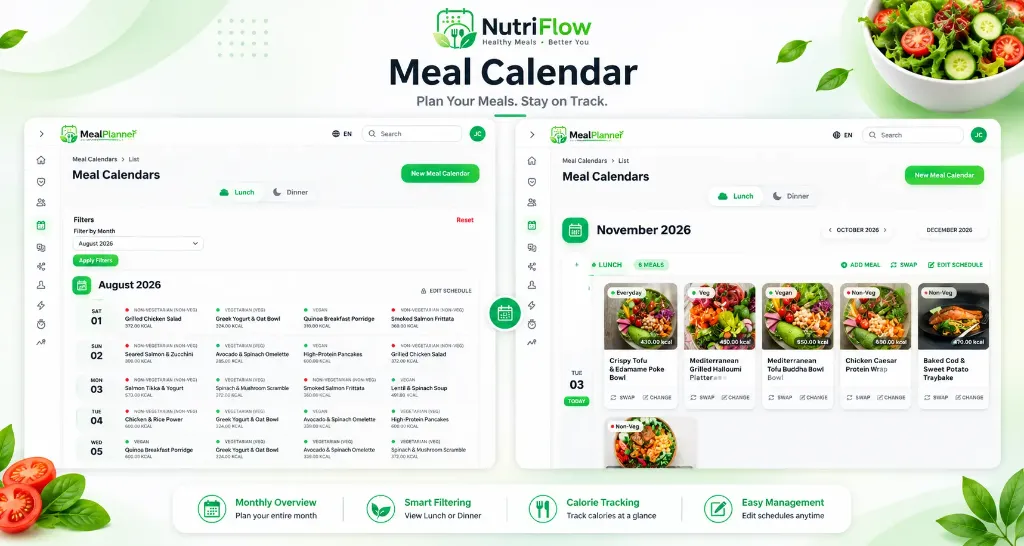
- Controlled Variant Swapping: Subscribers can swap their scheduled default entrees for any alternative dish within their active dietary tier (e.g., swapping a beef dish for a pescatarian bowl) up to the daily cutoff time.
- Portion & Macro Scaling: Subscribers can toggle protein sizes (e.g., standard 120g vs athlete 180g) with automated price adjustments calculated in real time.
- Rigid Production Cutoffs: The moment the cutoff countdown expires, the database locks all selections, generating immutable kitchen prep manifests.
2. The Two-Slot Swapping Protocol (Lunch & Dinner)
Many meal prep services make the mistake of treating daily meal plans as a monolithic unit: if a subscriber wants to change one meal, they are forced to modify their entire day's schedule.
NutriFlow implements an independent Two-Slot Swapping Protocol:
Subscribers select clean, energizing carbohydrates and lean proteins engineered for midday mental focus. Swaps can be managed independently from evening dining.
Subscribers can select lighter low-carb keto options, post-workout recovery bowls, or hearty family portions without disrupting their midday lunch configuration.
3. Enforcing Automated Cutoff Countdowns via Redis Queues
A kitchen cannot function if cutoff deadlines are loose guidelines. If the kitchen cutoff is 6:00 PM, the system must enforce that boundary with microsecond precision.
NutriFlow manages cutoffs through high-throughput Laravel 12 background workers:
- Interactive Mobile Countdowns: The Flutter mobile app displays a prominent live countdown ticker: "02h 14m 32s remaining to customize tomorrow's meals."
- Automated Cutoff Push Triggers: At T-2 hours and T-30 minutes, subscribers with unconfirmed custom orders receive high-priority push notifications.
- Atomic State Locking: When the countdown reaches zero, the system executes an atomic PostgreSQL transaction that transitions pending subscriptions into locked production batches. Any subsequent attempt to modify dishes is rejected gracefully with an informative message.
Building a Similar Meal Subscription Platform?
Get complete, unencrypted Flutter mobile apps, Laravel 12 multi-kitchen API, and Next.js 16 storefront code with zero ongoing revenue commissions.
Inquire on WhatsApp4. Automated Batch Prep Sheets by Ingredient & Cook Station
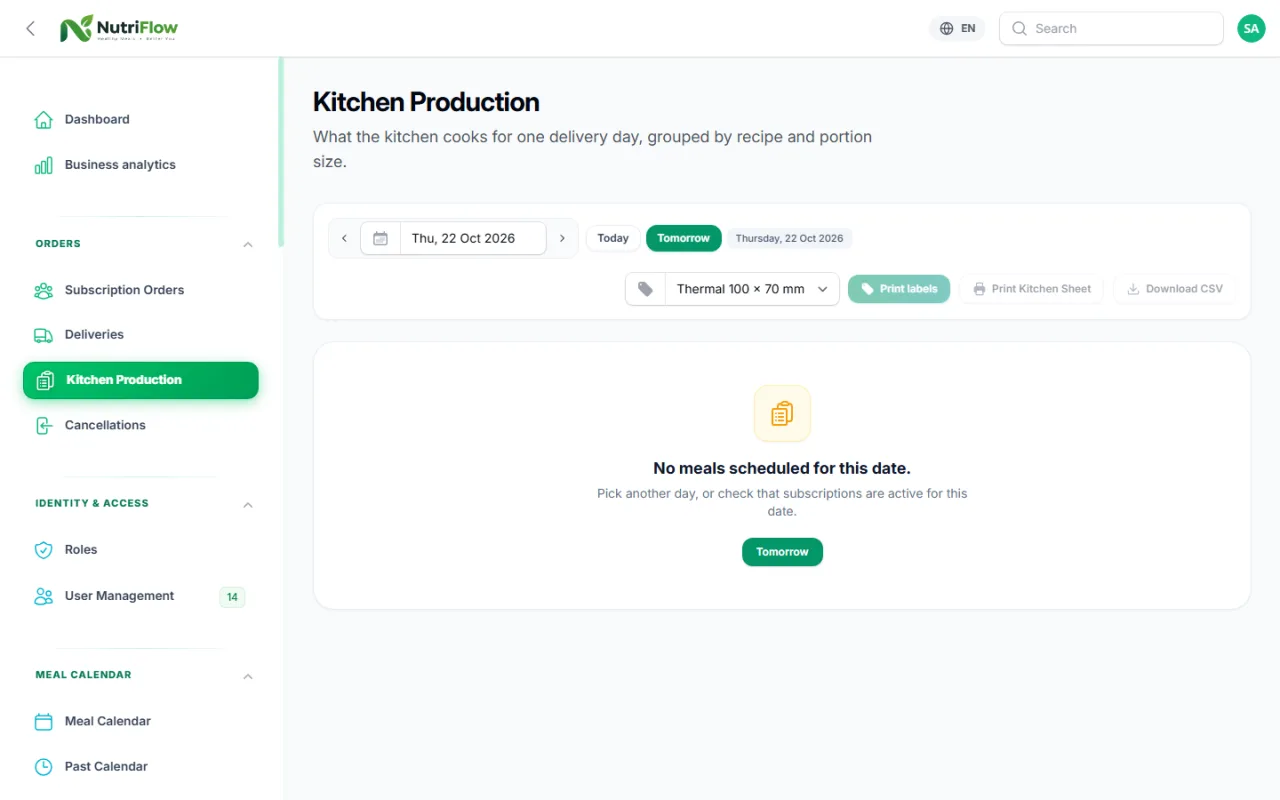
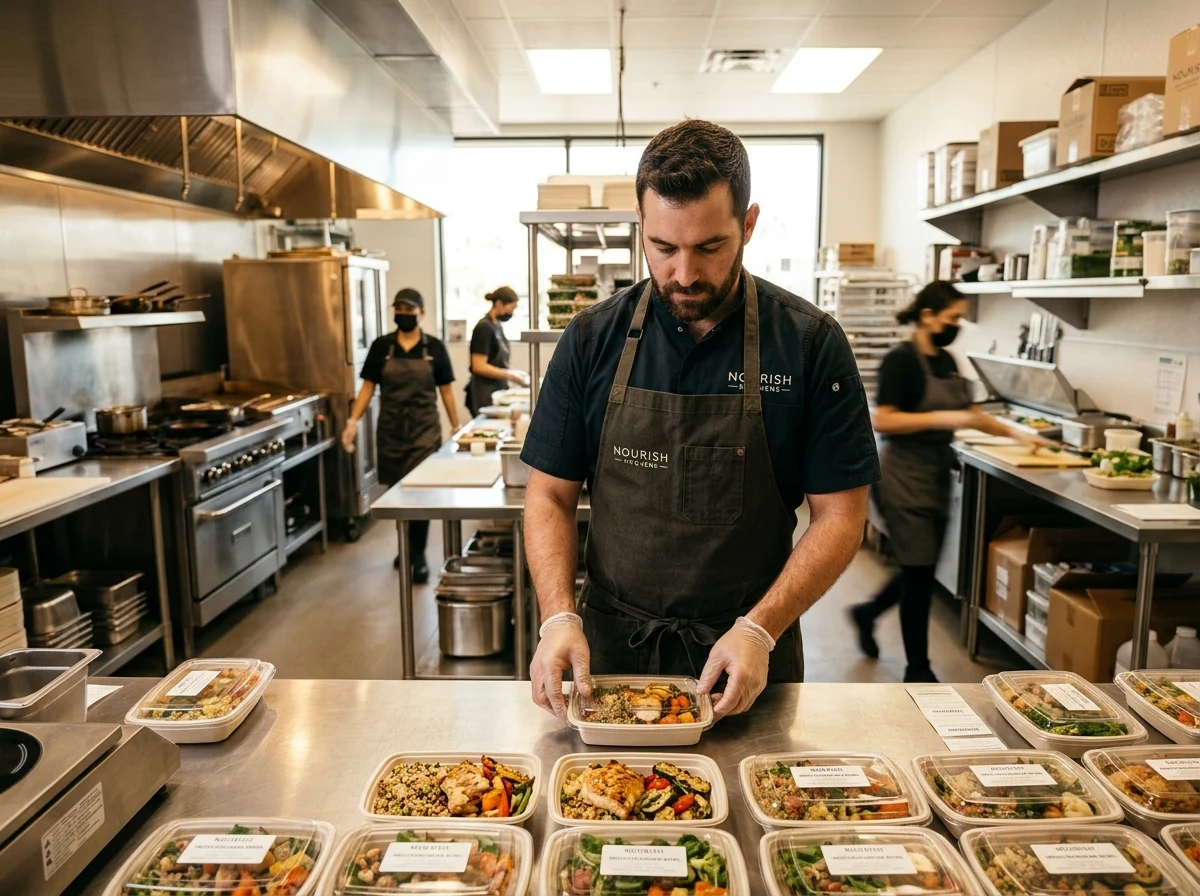
Once cutoffs are locked, NutriFlow converts hundreds of disparate customer orders into aggregated Station Cook Sheets:
| Kitchen Cook Station | Aggregated Requirement | Automated Waste Buffer (+3%) | Packaging Destination |
|---|---|---|---|
| Grill Station #1 (Poultry) | 142 x 150g Lemon Herb Chicken | 21.9 kg raw weight required | Trays #101 – #243 |
| Grill Station #2 (Red Meat) | 88 x 160g Flank Steak Strips | 14.5 kg raw weight required | Trays #244 – #332 |
| Oven / Roasting Station | 230 x 120g Roasted Herb Potatoes | 28.4 kg raw weight required | Assembly Line Alpha |
| Steam & Grain Station | 190 x 140g Steamed Quinoa & Brown Rice | 27.4 kg cooked weight required | Assembly Line Beta |
5. The 14 Major Food Allergen Exclusion Protocol
In commercial food service, managing allergens is a matter of life and safety. Cross-contact in commercial kitchens can trigger life-threatening anaphylactic reactions.
NutriFlow enforces a zero-tolerance 14 Major Food Allergen Exclusion Matrix across its database schema:
- During onboarding, subscribers select any allergens they must avoid (Gluten, Peanuts, Tree Nuts, Milk, Crustaceans, Eggs, Fish, Sesame, Soy, Celery, Mustard, Lupin, Molluscs, Sulphites).
- When a subscriber navigates the meal swap screen, recipes containing their active allergen exclusions are completely filtered out or marked with prominent hazard warnings.
- On the kitchen packing line, thermal tray labels print excluded allergens in bold red banners, alerting packers to verify cross-contact protocols before sealing.
NutriFlow's labeling engine fully satisfies UK Natasha's Law and EU Regulation 1169/2011 mandates by dynamically formatting all 14 major allergens in bold, distinct typeface on physical packaging seals.
6. PostGIS Polygon Geofencing & Fleet Manifest Routing
Managing driver dispatches without geospatial intelligence leads to late deliveries and cold meals.
NutriFlow leverages PostgreSQL with PostGIS:
- Kitchen managers draw visual delivery polygons directly onto Google Maps in the Filament admin panel.
- Customer addresses are geocoded into precise latitude/longitude points and indexed via spatial R-tree indices.
- The dispatch engine sorts stops into sequential, cluster-routed driver manifests, minimizing left-turns, bridge tolls, and transit bottlenecks.
7. Measuring Fulfillment Accuracy & Churn Reduction
Flawless logistics is the greatest retention engine in food tech. Operators utilizing NutriFlow's two-slot swapping and automated cutoff architecture consistently achieve:
- 99.8% Order Accuracy: Less than 2 mispacked meals per 1,000 deliveries.
- Under 2.2% Monthly Churn: High satisfaction driven by dependable meal choices and zero surprise deliveries.
- 100% On-Time Delivery: Morning delivery routes completed between 5:30 AM and 7:00 AM before subscribers leave for their workdays.
Frequently Asked Questions

Richie
Head of Culinary Logistics & Dietary SafetyRichie leads culinary logistics, nutritional safety, and commercial kitchen workflows at NutriFlow. With deep expertise across high-volume batch prep, dietitian-led clinical programs, and strict 14 major allergen management, Richie helps food entrepreneurs scale subscription kitchens safely.